
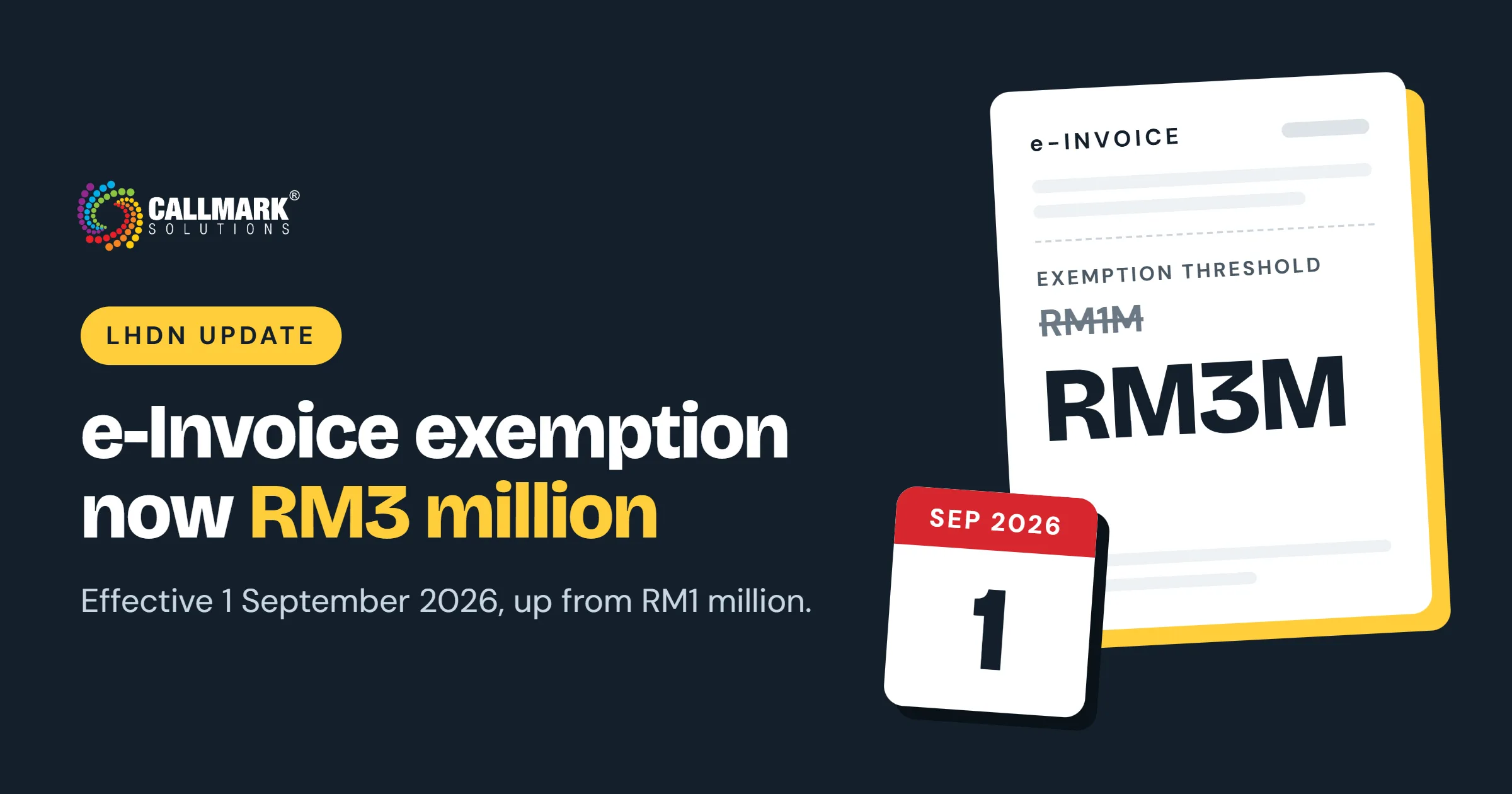

Short Answer: From 1 September 2026, the e-Invoice exemption threshold in Malaysia is RM3 million in annual turnover or revenue, up from the earlier RM1 million. However, the exemption does not apply if the business is linked to a company with RM3 million or more in turnover, such as a holding company, a related company, a joint venture or a non-individual shareholder.
What changed?
The Prime Minister announced the change on 30 August 2026, and the Inland Revenue Board of Malaysia (LHDN) confirmed that the e-Invoice implementation threshold was raised from RM1 million to RM3 million, effective 1 September 2026. LHDN said the change benefits more than 1.1 million businesses. The update was published in LHDN’s e-Invoice Guideline Version 4.8, dated 30 August 2026.
What are the e-Invoice phases now?
LHDN rolled out e-Invoicing in phases based on annual turnover or revenue:
- Phase 1: more than RM100 million, from 1 August 2024
- Phase 2: more than RM25 million up to RM100 million, from 1 January 2025
- Phase 3: more than RM5 million up to RM25 million, from 1 July 2025
- Phase 4: up to RM5 million, from 1 January 2026, with a relaxation period until 31 December 2027
With the new threshold, businesses below RM3 million that meet the exemption criteria fall outside the mandate. Businesses between RM3 million and RM5 million remain in Phase 4.
Who is still required to comply even below RM3 million?
According to the guideline, a business below RM3 million is not exempt if it has:
- A non-individual shareholder with annual turnover or revenue of at least RM3 million
- A holding company with annual turnover or revenue of at least RM3 million
- A related company or joint venture with annual turnover or revenue of at least RM3 million
New businesses that started between 2023 and 2025 with annual turnover or revenue of at least RM3 million must implement e-Invoicing from 1 July 2026.
I already started issuing e-Invoices. Can I stop?
LHDN’s FAQ includes examples where taxpayers who meet the exemption criteria may discontinue e-Invoicing. Because the answer depends on your turnover history and company structure, check LHDN’s latest FAQ or confirm with your tax agent before changing anything.
What should business owners do now?
- Check your annual turnover or revenue against the RM3 million threshold.
- Check your company structure: shareholders, holding company, related companies and joint ventures.
- If you are between RM3 million and RM5 million, keep preparing. The relaxation period runs until 31 December 2027.
- If you are close to RM3 million, keep your system ready, since growth could bring you back into the mandate.
- Keep your customers informed if your invoicing process changes.
Where does CALLMARK Solutions come in?
Regulation changes like this add admin work, and that time often comes from customer-facing tasks. CALLMARK Solutions offers inbound and outbound call support as well as back office support for Malaysian businesses, so your team can stay focused on customers while routine work is handled.
Frequently Asked Questions
What is the new e-Invoice exemption threshold in Malaysia?
RM3 million in annual turnover or revenue, effective 1 September 2026, raised from RM1 million.
Is every business under RM3 million exempt?
No. Businesses linked to a company with RM3 million or more in turnover, through shareholding, a holding company, a related company or a joint venture, still need to comply.
When does the Phase 4 relaxation period end?
31 December 2027.
This article is general information, not tax advice. Always check LHDN’s latest e-Invoice guidelines and FAQs at hasil.gov.my or consult a licensed tax agent.
Sources: